The science behind effective skincare comes down to a simple framework: the skin barrier needs three distinct kinds of help, and most celebrated ingredients—from ceramides to hyaluronic acid to peptides—each deliver exactly one of them. Ceramides, cholesterol, and fatty acids supply the structural lipids that hold the barrier together. Humectants like hyaluronic acid and glycerin attract and hold water within the skin. Peptides act as messengers, instructing skin cells to carry out repair and renewal. Understanding these three roles turns an intimidating ingredient list into a readable map of what a formula actually does.
Understanding Your Skin's Protective Shield: The Skin Barrier
The skin barrier is the outermost defense of the epidermis, and its health governs both how skin functions and how it looks. Writing in the Journal of Clinical and Aesthetic Dermatology, clinicians describe the barrier's core job as managing transepidermal water loss (TEWL) and stratum corneum hydration, noting that healthy skin continuously runs self-repair mechanisms to counter increased water loss and decreased hydration. When those repair mechanisms falter, barrier-related impairments follow—including in disease-affected skin, where specific structural and functional dysfunctions appear. The same clinical review emphasizes that adjunctive skincare, with product selection tailored to the individual, is a vital component of dermatologic practice.
For the everyday consumer, this means barrier care is not a niche concern for people with diagnosed conditions. Every formulation that promises resilience, radiance, or reduced dryness is, at the biological level, attempting to support this one structure.
The 'Brick and Mortar' Structure of the Stratum Corneum
The barrier itself lives in the stratum corneum, the outermost layer of the epidermis, and researchers describe it with a construction metaphor: bricks and mortar. The "bricks" are corneocytes—flattened, dead skin cells that, according to educational materials from the skincare brand Maya Chia, contain natural moisturizing factors (NMFs) that hold water, provide structural integrity through keratin proteins, form a physical barrier against penetration, and carry enzymes that regulate desquamation, the skin's natural shedding process.
The "mortar" is the lipid matrix sitting between and around those bricks. This is not a random smear of oils: it forms a sophisticated lamellar—layered—structure whose specific organization is crucial to barrier function. In that matrix, Maya Chia's educational breakdown assigns precise proportions: ceramides make up 40 to 50 percent of the lipids, cholesterol about 25 percent, and free fatty acids 10 to 20 percent, with other lipids including triglycerides, phospholipids, and cholesterol sulfate filling out the mix.
Structural Lipids: The Mortar's Foundation
Ceramides are the headline lipid, and the scientific literature gives them weight beyond simple structure. A peer-reviewed review published through the National Library of Medicine describes ceramide-induced mitophagy—the clearance of dysfunctional mitochondria—as contributing to an intact skin barrier, because dysfunctional mitochondria produce excessive superoxide that could kill the very cells needed to maintain the barrier. Ceramides are also converted in the skin to sphingomyelin and further metabolized to sphingosine-1-phosphate, a molecule whose signaling controls keratinocyte proliferation and induces differentiation.
The practical implication for a shopper is direct: a formula containing ceramides, cholesterol, and fatty acids is supplying the raw mortar. Disruption of ceramides, the same review notes, may lead to barrier disruption. This is why ceramide-containing formulas are often positioned for resilience and reduced water loss rather than for immediate surface softness.
Hydrators: Maintaining Moisture and Flexibility
Where lipids seal the mortar, hydrators work from the inside of the bricks. Natural moisturizing factors, found within corneocytes, attract and bind water, maintaining the hydration and flexibility that let the stratum corneum function. A well-formulated hydrator supplements this internal water-holding system rather than replacing it.
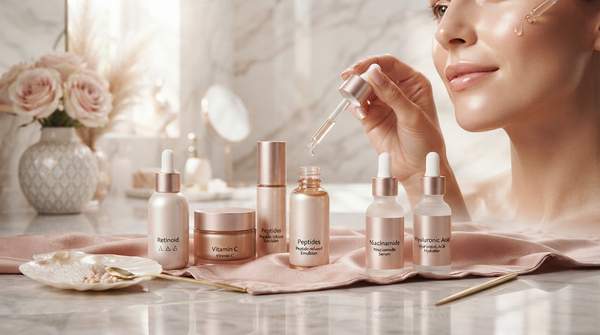
The ingredient list reflects this division of labor. Maya Chia's educational guide places hyaluronic acid, glycerin, panthenol, and squalane among barrier-supporting ingredients, alongside niacinamide and omega-3 fatty acids from sources like chia seed oil and fish oil. The same guide adds an important caution: some popular ingredients—strong AHAs and BHAs at high concentrations, retinoids on a damaged barrier, denatured alcohol high in an ingredient list, fragrance, some essential oils, and harsh sulfate surfactants—can compromise the barrier when overused or applied to already-damaged skin. Many of them remain valuable when used appropriately on healthy skin.
Signaling Molecules: Directing Cellular Repair and Renewal
The third category works neither as structure nor as moisture but as instruction. Peptides are short chains of amino acids that act as messengers, and reporting from Resident Magazine describes the mechanism in functional terms: "collagen production stays steady because the signaling peptides are constantly instructing the fibroblasts to work." Fibroblasts are the cells that produce collagen and other structural components of the skin's deeper tissue, and the signaling relationship is what distinguishes peptides from every other ingredient category.
This is the biological logic behind the market trend. As one industry analysis of luxury formulation put it, the goal is no longer to "cover up damage or strip the skin" but to "support the biological functions that keep tissue resilient over decades"—a shift in which the skin is treated as "a living, reacting ecosystem." Industry reporting in the professional spa and skincare press echoes the same consumer expectation: buyers increasingly want to understand why a formula is worth the investment, and formulators are responding with what that outlet describes as balanced formulas in which each ingredient serves a purpose.
Functional Framework for Skin Barrier Ingredients
The table below classifies the most common barrier-focused ingredients by their primary mechanism of action. Its purpose is practical: when you encounter a new ingredient on a label, you can ask which of the three jobs it performs—providing structure, retaining water, or signaling cells.
| Ingredient Category | Biological Role | Example Ingredients |
|---|---|---|
| Structural lipids (the "mortar") | Form the lamellar lipid matrix of the stratum corneum's mortar, preventing transepidermal water loss and blocking external stressors | Ceramides (40–50% of barrier lipids), cholesterol (about 25%), free fatty acids (10–20%) |
| Hydrators / humectants | Attract and bind water within corneocytes, working alongside natural moisturizing factors to maintain hydration and flexibility | Hyaluronic acid, glycerin, panthenol, squalane |
| Signaling molecules | Act as molecular messengers that instruct skin cells such as fibroblasts, supporting collagen production and ongoing renewal processes | Signaling peptides |
Read the table as a coverage checklist rather than a ranking. A single formula does not need every category in every product, and the proportions above describe the barrier's own composition, not a required product recipe. The framework also explains why layering different product types—rather than stacking five serums with the same mechanism—matches the biology.
Making Informed Skincare Choices for Barrier Health
The through-line of the evidence is that barrier health is a multi-mechanism problem: structure, hydration, and cellular communication each address a different failure mode, and no single ingredient covers all three. Readers can make more informed purchasing decisions by understanding these distinct biological roles—and the practical test is simple. The next time you pick up a new product, identify the primary function of each unfamiliar ingredient on the label in relation to barrier support: is it supplying lipids, holding water, or signaling cells? If you can answer that, you can judge whether the formula fills a gap in your routine, duplicates something you already use, or risks compromising the barrier through overuse of acids, retinoids, or irritants.
Two boundaries deserve the final word. This framework concerns the biology of healthy skin and everyday formulation literacy; it is not medical advice, and barrier-related impairments in disease states warrant individualized clinical evaluation, as the dermatology literature itself stresses. And "luxury" here refers to ingredient sophistication and formulation intelligence, not price point—the industry's own analysis says as much. The measurable outcome is a changed relationship with the label: a reader who once saw an alphabetical mystery now sees structure, water, and signal.
Sources
- Skin 101: Understanding the Fundamentals of Skin Barrier Physiology—Why is This Important… — JCAD - The Journal of Clinical and Aesthetic Dermatology
- Skin Barrier Function: The Interplay of Physical, Chemical, and Immunologic Properties - PMC
- The Science of Skin Barrier: Your First Line of Defense Against Aging — Maya Chia
- Molecular Skincare: The Rise of Biocompatible Formulations in Luxury Dermatology — Resident™ Magazine
- Skininc