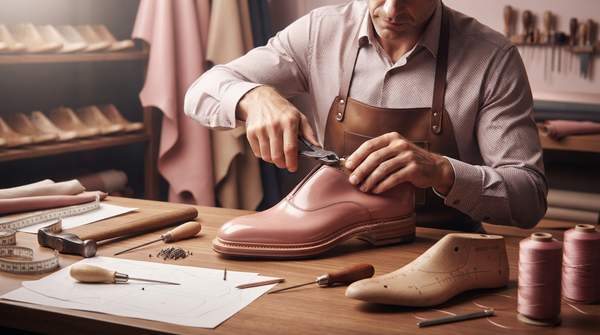
A bespoke luxury shoe earns its perfect fit long before any leather is stitched. The decisive moment comes early, when a master artisan carves a custom "last" — a three-dimensional model of the client's own foot — and every stage that follows, from pattern cutting to hand-polishing, builds on that foundation. Here is how the process works, stage by stage.
The Bespoke Shoemaking Journey: An Overview
Bespoke shoemaking is not a single craft but a relay of specializations. According to the Italian Shoe Factory, which documents its own production process, a handmade shoe may pass through as many as 70 steps — or as many as 300 — before it leaves the workshop. What unites these steps is a single logic: the shoe is built around the client's foot rather than the foot being asked to adapt to the shoe.
The journey compresses into six core stages: consultation and measurement, last-making, pattern cutting and clicking, lasting the upper, sole attachment, and hand-finishing. Each stage depends on the one before it, and each is typically the responsibility of a distinct artisan. While specific titles and divisions of labor vary between ateliers, the principle of specialized roles remains consistent across the tradition.
The Bespoke Shoemaking Timeline
The table below sequences the stages described by shoemakers and craft references into a single production timeline, showing what happens at each step and how it contributes to the final fit and quality.
| Stage | Artisan Role | What Happens | Contribution to Fit and Quality |
|---|---|---|---|
| 1. Consultation & Measurement | Master Last-Maker | Detailed foot measurements, pictures and scans; client selects style, materials and design | Establishes the foundation for the custom fit and aesthetic |
| 2. Last Making | Master Last-Maker | A custom last — a mould emulating the client's foot — is carved from wood or plastic, one for each shoe | Foundational: determines the shoe's fit, structure and appearance |
| 3. Pattern Cutting & Clicking | Designer / Cutter (clicker) | A paper pattern (vamp, cap, tongue, quarters) is made and pieces are cut from leather | Maximizes leather use, avoids flaws, respects stretch lines and colour-shading |
| 4. Lasting the Upper | Shoemaker | The leather upper is stretched and shaped over the custom last with specialized tools | Conforms the shoe precisely to the last's shape for a perfect fit |
| 5. Sole Attachment | Shoemaker | The sole is attached, often with hand-welted stitching; linings may be added | Provides structural integrity and durability |
| 6. Shaping & Finishing | Finisher | Excess leather is trimmed, edges refined, surface polished and conditioned | Enhances appearance, protection and longevity |
Stage 1: Consultation, Measurement, and Last Creation
The process begins with the client's foot, not with the shoe. As the Italian Shoe Factory describes it, the Master Last-Maker measures the client's foot while the client chooses the shoe shape, materials and design. The measurements are supplemented with pictures and scans of the foot, recorded so the workshop can refer back to every intricate detail.
Then comes the step that separates bespoke from everything else: the last. A last is a mould that emulates a foot to give the shoe its shape, carved from wood or plastic, with one required for each left and right shoe. But as the Italian Shoe Factory emphasizes, it is "no vague foot-shaped lump of wood" — the last-maker must account for how the foot rolls during walking and how that affects factors such as heel height.
Why does this matter so much? Because, as shoemaking writer Kamyar Chamasmani explains, "The fit, structure, and appearance all depend on how the last is shaped." In bespoke work, artisans create custom lasts specifically for a client's feet, which "ensures a perfect fit and transforms the shoe into something uniquely personal." The last is placed inside the shoe during construction so the shoe can be modelled around it, and it is used again near completion to verify that the final fit matches the original design.
Stage 2: Pattern Cutting and Material Selection
With measurements and the finished last in hand, the Shoe Designer or Cutter takes over. The first task is a paper pattern for the chosen style, composed of pieces with names that may sound strange to the uninitiated — vamp, cap, tongue, and quarters. These pieces are then cut from the selected leather, a task traditionally performed by a clicker.
Clicking is a skilled trade in its own right. As craft references describe, the clicker's responsibility is to maximize the number of uppers cut from each skin while avoiding thin and damaged areas and incorporating the unseen lines of stretch and resistance that naturally occur in leather. The clicker must also colour-shade the parts of each pair, matching not just colour variations but surface finish and grain texture.
Material choice carries equal weight. The most commonly used material for luxury footwear is full-grain calfskin leather, regarded in the trade as the finest available. Full-grain leather retains the natural strength of the hide and develops a patina over time — an aging process that gives the shoes character and individuality as they are worn.
Stage 3: Lasting the Upper
Lasting is where the shoe acquires its final form. In a detailed exploration of the stage, Bondeno's Charles Kelso describes lasting as holding "a place of paramount importance" among the many stages of bespoke construction: it shapes the shoe, gives it its final form, and ensures it fits the wearer's foot perfectly.
The process is both art and science. The shoemaker must understand materials, anatomy, and construction techniques to achieve the intended fit and finish, stretching and positioning the upper over the last with, in Kelso's words, "a keen eye for detail and a steady hand." Before the shoe moves on, the shoemaker conducts a thorough inspection — checking fit, alignment and overall quality, refining the shape, smoothing edges, and ensuring the upper is free from wrinkles, creases or imperfections.
Stage 4: Sole Attachment and Construction
Once the upper has been lasted and inspected, the shoe is ready for the next stage of construction, which may include attaching the sole and adding linings. In the finest work, this is done through hand-welted construction: each stitch is placed by hand, creating a durable and flexible connection between the upper and the sole. This stage supplies the shoe's structural integrity — the reason a well-made bespoke shoe can be worn, resoled, and worn again for years.
Stage 5: Hand-Finishing and Polishing
After the sole is attached, the shoe enters the finishing phase. Artisans trim excess leather, refine the edges, polish the surface, and check that every detail meets the workshop's standards. Luxury shoes typically undergo several rounds of polishing and conditioning before leaving the workshop — finishing touches that enhance both appearance and longevity. The result, as Chamasmani puts it, is footwear that combines craftsmanship, comfort, and timeless style.
One caveat is worth holding in mind: this describes the general traditional process for leather dress shoes. Specific techniques and the exact number of steps vary between artisans and workshops, and this account does not extend to other forms of bespoke footwear such as boots or athletic shoes.
Appreciating Bespoke Craftsmanship
When considering bespoke luxury footwear, recognize that its superior fit, durability, and aesthetic value are direct results of a multi-stage, highly specialized artisanal process, centered on the custom last. The measurement session feeds the last; the last shapes the pattern; the pattern becomes an upper that is stretched over that same last; and the welted sole and hand-applied finish lock the result in place.
The observable signal of this process is the presence of a perfectly contoured fit, high-quality material finish, and structural integrity that distinguishes bespoke shoes from mass-produced alternatives. A reader evaluating a bespoke commission can check for exactly these markers — and, tellingly, can ask the atelier whether the last is carved for their feet alone, since that single object is where the entire value of the process begins.
Sources
- Shoemaking Process: How Shoes Are Made — Italian Shoe Factory
- How Handmade Luxury Shoes Are Made — Mensitalianshoes
- Boot and shoe clicker - Wikipedia — EN
- The Art of Lasting in Bespoke Shoemaking: A Detailed Exploration — Bondeno