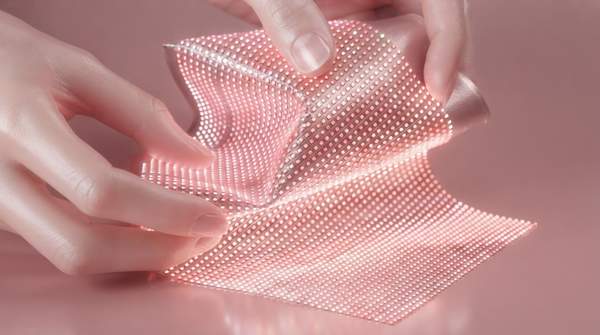
Smart textiles are fabrics that sense a change in the wearer or the surroundings—heat, moisture, pressure, movement or a heartbeat—and, in their more advanced forms, react or adapt to it. In luxury fashion, the technology is real but the market is not: garments that illuminate, thermoregulate or monitor biometrics exist today, yet their adoption in high-end apparel is constrained by a tangle of technical, manufacturing and aesthetic hurdles. Understanding why requires distinguishing between fundamentally different kinds of "smart" fabric, because not all smart textiles carry the same complexity, cost or risk.
Defining Smart Textiles: Beyond Traditional Fabrics
The defining characteristic of a smart textile is responsiveness. Where a conventional fabric is passive material, a smart textile incorporates sensing capability—and sometimes actuation and decision-making—into the fabric itself. Textile School's technical primer describes the spectrum plainly: fabrics that detect stimuli such as heat, moisture, pressure, movement or a heartbeat, with the more advanced kinds reacting or adapting to what they detect.
The sensing is typically inherent to the material or its integrated components: conductive threads woven through the textile carry signals, and embedded electronics translate them into data or action. Real products already demonstrate the principle. Shirts that record ECG and breathing, such as those made by Hexoskin, and socks that monitor foot temperature for people with diabetes, made by Siren, show how a garment can double as a physiological sensor. In fashion specifically, the fabric itself can become the display—as in illuminated stage dresses or touch-sensitive denim cuffs.
Crucially, these examples are illustrative of the technology rather than a census of luxury houses. Most current commercial applications sit in sportswear and medical monitoring, but the mechanisms they demonstrate—sensing, actuation, display—are the same ones a couture house would need to master.