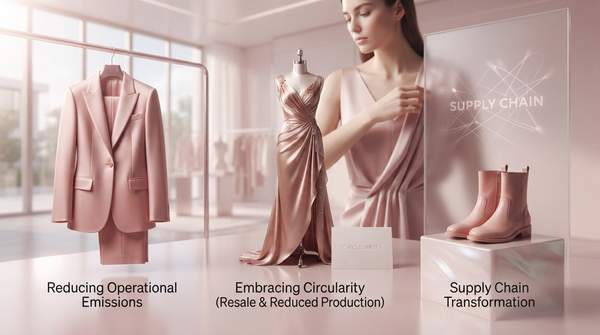
Luxury fashion's climate response rests on three distinct strategic pillars: decarbonizing operations and supply chains, embracing circular business models such as resale and reduced overproduction, and exerting industry-wide influence through collaborative charters. Understanding this framework allows professionals and consumers alike to situate any brand initiative—whether a renewable-energy commitment, a repair service, or a signature on a sector-wide pledge—within a coherent strategy.
Introduction: Luxury Fashion's Multi-Faceted Climate Response
Fashion accounts for approximately 2% of global emissions, yet only 11% of the industry's market value is on track to meet 2030 targets, according to a 2025 analysis by Bain & Company. Against that backdrop, the luxury segment has developed a response that extends well beyond headline material innovations. A report on climate change implications for the luxury fashion sector—produced by the sustainability advisory firm BSR together with Kering—frames the task as a "resilience agenda" with dual aspects: mitigation, meaning greenhouse gas emission reduction, and adaptation, meaning capacity-building measures companies take in their own operations and value chains to manage risk.
The same analysis identifies five main climate-related risks facing luxury fashion companies: input, physical, market, stakeholder, and regulatory. The importance of each varies over time and geography, which is why the report urges companies to scrutinize their supply chains and operations closely. The strategies below represent three complementary ways of doing so.
Pillar 1: Operational Decarbonization and Supply Chain Efficiency
The first pillar concerns what happens inside the company and along its value chain. The BSR-Kering report argues that luxury brands can contribute to a low-emissions economy by reducing their own greenhouse gas emissions and implementing measures at key points in their value chains that also facilitate adaptation.
The report's recommended areas of attention reach well beyond raw material production and processing. They include product design and manufacturing; more effective energy and fuel management across manufacturing facilities, offices, stores, and logistics; the efficient siting of facilities and stores; and investing in and procuring from suppliers that are climate resilient. Each lever targets emissions at a different stage of the chain, from upstream fiber choices to downstream distribution. The report also notes that natural capital accounting methodologies, such as Kering's Environmental Profit & Loss statement, offer one way of measuring impact and exposure across these operations.
Pillar 2: Embracing Circular Business Models for Reduced Impact
The second pillar changes the product lifecycle itself, and here the luxury segment has levers unavailable to volume apparel. The Bain & Company analysis, drawing on marginal abatement cost curve (MACC) analysis, concludes that the decarbonization paths of fashion and luxury apparel diverge: while fashion apparel must prioritize sourcing and energy, luxury can improve forecasting and resale.
According to that analysis, reducing overproduction and scaling resale—particularly in the luxury segment—stand out as credible levers with the potential to deliver both climate impact and commercial returns. The logic is specific to luxury: better forecasting curbs the wasted production that generates emissions without generating sales, while resale monetizes the durability and lasting desirability that already define high-end goods. The Bain authors argue that done right, these steps "can unlock the operational and financial headroom required to go further," and that decarbonization should be treated not as a standalone initiative but as a business discipline embedded in sourcing, supply chain, inventory management, and product strategy.
Real-world signals of this pillar appear in programs convened by the Council of Fashion Designers of America, whose sustainability programming includes panel discussions on luxury resale and sustainability with the resale platform Fashionphile, and a collaborative podcast series with The RealReal—formats in which industry figures explore resale as a sustainability topic rather than merely a commercial channel.
Pillar 3: Industry-Wide Influence and Collaborative Action
The third pillar extends beyond any single company. The UN Climate Change secretariat's Fashion Industry Charter for Climate Action, established in response to the 2018 IPCC Special Report on Global Warming of 1.5°C, frames immediate action as necessary for the fashion sector to align with the Paris Agreement and move toward net-zero emissions by 2050.
UN Climate Change convenes fashion stakeholders to develop a coherent, unified position on climate, deliberately connecting the diverse actors of the industry—raw material producers, textile producers, apparel manufacturers, and brands—to identify new areas for action and scale up existing initiatives that connect the value chain. Individual brands can also exert influence through their cultural position: the BSR-Kering report argues that luxury brands can harness their leadership position as "influencers" to build awareness and excitement around a climate-smart world, catalyzing action through their clients and more broadly in the public sphere. The CFDA's collaborative series with LVMH, which convenes leaders in conscious fashion and luxury around topics from biodiversity and circularity to climate action, illustrates this convening role in practice.
Luxury Fashion's Climate Action Pillars
The table below categorizes the three pillars, comparing their primary goals and the specific levers each entails. Use it to classify any initiative a brand announces: internal operational changes belong to the first pillar, product lifecycle changes to the second, and external influencing actions to the third.
| Strategy Pillar | Primary Goal | Key Levers & Examples |
|---|---|---|
| Operational Decarbonization | Mitigate climate change by reducing the carbon footprint of production and distribution across the entire value chain | Product design and manufacturing; energy and fuel management in facilities, offices, stores, and logistics; efficient siting of facilities; sourcing from climate-resilient suppliers |
| Circular Business Models | Reduce environmental impact by minimizing new production and maximizing product utility | Reducing overproduction through better forecasting; scaling resale, as identified for the luxury segment by Bain & Company's analysis; repair-focused dialogue in CFDA programming |
| Industry-Wide Influence | Accelerate the transition to a net-zero fashion industry through shared commitments and best practices | The UNFCCC Fashion Industry Charter for Climate Action and its convening of raw material producers, textile producers, manufacturers, and brands; brand leadership as cultural "influencers"; CFDA collaborations with LVMH and resale platforms |
The distinction matters because the pillars answer different questions. Operational decarbonization asks how goods are made with fewer emissions; circular models ask whether fewer new goods need to be made at all; influence asks how the whole sector, and its customers, can be moved. The evidence supports categorizing these strategies but not quantifying their emissions reductions, so the framework describes types of action rather than measured outcomes.
Navigating Luxury Fashion's Climate Commitments
Industry professionals and environmentally conscious consumers should evaluate luxury fashion brands' climate action by identifying which of the three strategic pillars—operational decarbonization, circular models, or industry influence—their initiatives fall under. The measurable indicator is the presence of specific programs or participation in charters that align with these defined strategic pillars: a named supply chain energy or sourcing program for the first, a resale, repair, or forecasting initiative for the second, and signatory status in or documented engagement with collective frameworks such as the Fashion Industry Charter for the third. As the Bain & Company authors put it, "Fashion doesn't need more pledges. It needs precision, pragmatism, and pace"—and a pledge becomes evaluable only once it can be located within a pillar that has concrete programs behind it.