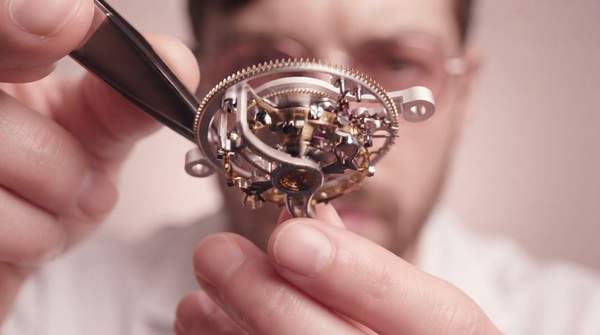
A tourbillon is a rotating cage that houses a watch's escapement and balance wheel, spinning continuously—typically once per minute—to average out the timing errors gravity inflicts on a mechanical movement. Invented by Abraham-Louis Breguet in 1795 and patented in 1801, it was born as a practical fix for pocket watches. Today, I'd argue it has become something else entirely: the single most recognizable declaration of horological mastery a watchmaker can make.
What Is a Tourbillon? An Introduction to Horological Ingenuity
In the realm of haute horology, the tourbillon stands as a pinnacle of mechanical innovation—a complication usually showcased through an aperture cut into the dial, where its hypnotic rotation is impossible to ignore. But the word "complication" undersells it. A tourbillon is not an added function like a chronograph or a moon phase; it is a re-engineering of the watch's beating heart itself.
The mechanism places the escapement—the organ that regulates the flow of energy through the gear train—and the balance wheel, which oscillates to measure time, inside a small cage that turns on its own axis. Watch enthusiasts regard it as the most revered complication in watchmaking, and the prices it commands reflect that prestige. Yet its hypnotic rotation is only the surface of the story. The deeper tale is one of problem-solving: a specific physics problem, elegantly answered.
The Problem: Gravity's Distorting Effect on Pocket Watches
To understand why Breguet bothered, you have to understand what a pocket watch endures. A pocket watch spends its life in a fixed vertical position—in a vest pocket, hanging from a chain. In that posture, gravity constantly pulls on the balance wheel in one direction. Depending on whether the heaviest part of the balance sits at the top, bottom, or side, the watch runs slightly faster or slower. Over the course of a day, those errors accumulate into visible drift.
Breguet's own study of the balance wheel led him to identify the culprits behind these gravity-induced errors: perturbing torques, wear and friction, and lubrication. In a standard movement, gravity can pull on the escapement and cause variations in timekeeping that no amount of careful regulation could fully eliminate, because the watch simply never changes position enough to cancel them out.