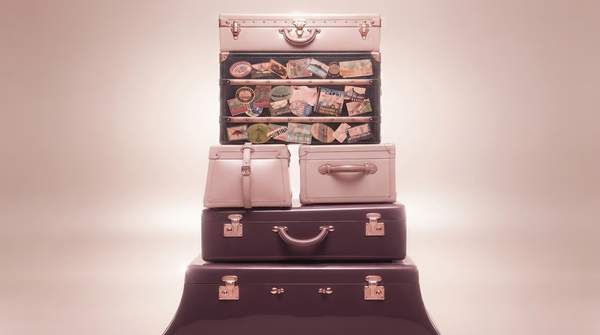
The story of the Louis Vuitton trunk is, at its heart, a story of problem-solving. The flat-topped trunk of 1858 solved the practical problem of stacking luggage in the holds of steamships and railway baggage cars. The succession of signature canvases — Rayée in 1872, Damier in 1888, and the Monogram in 1896 — solved a commercial one: the persistent imitation of a design that had become fashionable. Understanding these two threads, structural innovation and material evolution, is the key to appreciating why a nineteenth-century packing case remains a cultural icon.
Foundational Innovations: The Flat-Top Trunk and Early Canvases
Louis Vuitton founded his company in 1854 on Rue Neuve des Capucines in Paris, and the very first Louis Vuitton trunk followed in 1858, according to the historical account published by LV Trunks. What made it remarkable was not merely its craftsmanship but its geometry. It was the first trunk to have a flat top and bottom, so that it could be stacked and more easily transported. Previously, trunks of the day featured rounded tops to help water run off.
As Harper's Bazaar recounts, Vuitton's clients were travelling further, faster and more often, and he identified an opportunity to create hardier, more easily transportable luggage. The rectangular trunk he crafted could be stacked in a ship's hold or railway baggage car, unlike the domed designs of the time. Crucially, it was covered in Trianon canvas — a material that added no extra weight yet resisted damage — in a fashionable grey, the same colour as Empress Eugénie's salons. The marriage of utility and elegance was there from the very beginning.
The Battle Against Imitation: Evolution of Signature Canvases
Success brought imitators, and the canvas became the battleground. To protect against imitation, Vuitton replaced the grey Trianon canvas with a red and white striped canvas in 1872, later switching in 1876 to a beige and brown striped version. Both are known as Rayée canvas — "striped" in French — and the Rayée remained in use until 1888.
That year, Vuitton went further, introducing the Damier canvas, a checkerboard pattern that appeared in two colour schemes: the rarer red and white checker, and the more common light and dark brown checker. With the Damier pattern, Vuitton began placing "marque L. Vuitton déposée" — loosely, "L. Vuitton trademark" — inside each trunk, embedding ownership into the design itself. The Damier canvas is still used frequently today.
The most decisive answer to counterfeiters came after Louis Vuitton's death in 1892, when control passed to his son, Georges Vuitton. In 1896, Georges introduced the signature LV Monogram canvas, though the first Monogram was not sold until 1897. Its symbols — the interlocking LVs, the graphic flower and the quatrefoil — echoed the Oriental design trend of the late Victorian era, and the complex, interwoven pattern proved far harder to copy than a simple stripe. Security extended to hardware as well: in 1886, the company adopted a single-lock system with two spring buckles, described as an "unpickable" lock, to protect the trunk's contents.
Chronology of Louis Vuitton Trunk Innovations
The timeline below sequences the major design and material milestones, linking each innovation to the specific driver behind it — whether the changing mechanics of travel or the escalating war against counterfeiters.
| Date | Innovation / Event | Significance / Reason |
|---|---|---|
| 1854 | Company founding | Louis Vuitton establishes his company on Rue Neuve des Capucines in Paris. |
| 1858 | Flat-top trunk in grey Trianon canvas | First trunk with a flat top and bottom, allowing it to be stacked in ships' holds and railway baggage cars; the canvas added no extra weight yet resisted damage. |
| 1872 | Rayée canvas (red and white stripes) | Replaced Trianon to protect against imitation; a beige and brown striped version followed in 1876. |
| 1886 | Single-lock system with two spring buckles | An "unpickable" lock system introduced to secure the trunk's contents. |
| 1888 | Damier canvas | A checkerboard pattern introduced to further avoid imitation, with "marque L. Vuitton déposée" placed inside each trunk. |
| 1896 | Monogram canvas (first sold 1897) | Introduced by Georges Vuitton after his father's death in 1892; the complex pattern of interlocking LVs, flowers and quatrefoils further deterred copying. |
| 1905 | "Ideal" trunk | Sized for a week-long business trip or vacation, with compartments that opened like a toolbox; favoured by gentlemen travellers. |
| 2006 | Trunk designed for Wes Anderson | Example of bespoke special-order work for individual clients. |
| 2009 | Casino Trunk | Launched to celebrate the opening of the Louis Vuitton store in Macau, with compartments for a roulette wheel, 20 packs of cards and 800 poker chips. |
| 2021 | Party Trunk | A fully stocked home bar and entertainment centre, with space for 30 bottles, a plated silver ice bucket, a Monogram disco ball and a smoke machine. |
Adapting to Modern Travel: Specialized Trunks for Every Need
As the luxury travel industry evolved, Louis Vuitton adapted its trunks to suit the changing needs of its clients. In the early twentieth century, the company embraced the idea that it was not only clothing that could travel. The "Ideal" trunk, first introduced in 1905, was originally named "Perfect" because, as Christie's specialist Andreani explains, "it was the perfect — or ideal — size for a week-long business trip or vacation," and "the compartments within open up to reveal their contents like a toolbox."
The principle of the trunk as a portable world soon extended to every imaginable pursuit. The Hemingway library trunk — originally conceived by Gaston-Louis Vuitton for Ernest Hemingway — features drawers, convertible book compartments and space for a typewriter. In 2009, the Casino Trunk launched to celebrate the grand opening of the Louis Vuitton store in Macau, its exterior clad in the signature monogram print and its interior fitted with storage for gambling paraphernalia, including a roulette wheel, 20 packs of cards and 800 poker chips. "For collectors and enthusiasts, the Louis Vuitton Casino Trunk is more than just a piece of luggage," Andreani notes. "It is an extraordinary and elegant example of the brand's ability to blend luxury with functionality and entertainment."
More recently, the brand introduced the Party Trunk, a fully stocked home bar and entertainment centre complete with a plated silver ice bucket and a Monogram disco ball, with space for 30 bottles and a smoke machine. Christie's also observes that library trunks and other vintage models have transcended their original purpose as travel companions to become decorative collectables, doubling as chic coffee or side tables — a reminder that the trunk's utility has never been purely about transport.
Understanding the Enduring Appeal of Louis Vuitton Trunks
To fully appreciate Louis Vuitton trunks, discerning travellers and collectors should recognize their historical evolution as a continuous response to changing travel demands and the persistent challenge of imitation. Every milestone in the timeline above answers a question: how to stack luggage for a new age of transport, how to make a design unmistakably one's own, how to carry not just clothes but an entire way of life. The measurable indicator of this enduring adaptability is the introduction of specialized trunk designs and limited editions — from the Hemingway library trunk to the 2009 Casino Trunk and the Party Trunk — each demonstrating that the nineteenth-century "malle" remains a living, evolving form rather than a relic. Watching for the next such special-order or limited-edition release is the clearest way to see this tradition continue.
Sources
- The fascinating history of the Louis Vuitton trunk — Harper's BAZAAR UK
- History — LV Trunks
- Louis Vuitton trunks collecting guide — Christies