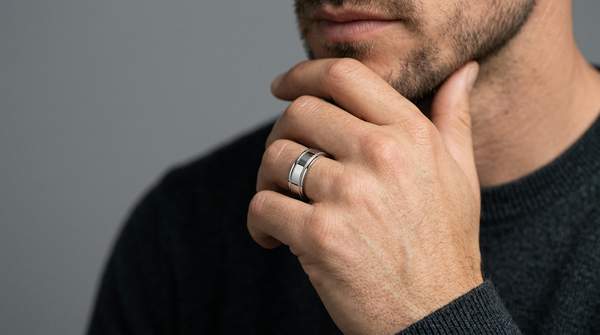
Milgrain is the detail you might miss during a handshake and see a dozen times a day on your own ring. It’s a row of tiny metal beads along an edge or border. On a wedding band it can give a polished surface a fine outline or lend texture to the setting around a row of diamonds.
Ritani’s 8 mm polished platinum wedding band gives the beading a broad expanse of smooth metal to frame. On the 1.8 mm bezel-set platinum band, the detail shares a much narrower space with round diamonds that alternate in size. One design draws your eye along the edges, while the other gives you several smaller shapes to follow across the top.
A Fine Border on a Wide Band
On Ritani’s 8 mm band, there’s enough uninterrupted platinum between the two beaded edges for the polished face to make a distinct impression. The fine rows bring your attention back to the top and bottom of that surface. The center can look broad and clean while the edges keep their own detail.
Picture the band on a hand wrapped around a coffee mug. You might see a broad reflection across the face first and a finer line at the edge when the hand tilts. That little border can move in and out of view in a moment as ordinary as passing the mug across the table.
Try the front view of the 8 mm band at a smaller scale before zooming in. In a close-up, every bead gets its own space, while a smaller image puts the proportion of the smooth face to the narrow borders in focus. That relationship will tell you more about the ring’s overall character than the size of any single bead.
A Narrow Band Gives the Detail a Different Rhythm
The 1.8 mm platinum band has a minimum total diamond weight of 0.20 carat. Its natural round diamonds alternate in size across the upper half, and a bezel, or metal rim, surrounds each stone. Milgrain brings a finer texture to a design that already has a series of round shapes for your eye to follow.
At a glance, the alternating circles are easy to pick out. From closer in, the metal beads bring texture to the outline you’ve already seen. The bigger pattern comes from the stones, so you can enjoy the shape of the band even when it takes a closer look to pick out the individual beads.
That rhythm can show up differently beside an engagement ring. If your engagement ring already has a decorative edge, the slim band can echo it. Beside a simpler ring, the small circles and milgrain add a new texture.
Because the diamonds occupy the upper half of the band, you can also look at how the row ends as the ring curves around your finger. From above, the circles lead across the hand. At a shallower angle, you can see the points where the diamonds give way to the rest of the band, which changes how the ring looks when you turn your hand.
An Old Detail With Room for a Modern Ring
The British Antique Dealers’ Association traces the popularity of milgrain through Edwardian and Art Deco jewelry. It appears along edges and around stones, where the fine beadwork can follow a curve or emphasize a geometric border. The scale of that detail can bring a hint of period jewelry to a ring with a simple outline.
On a modern band, a little of that history can go a long way. Next to a broad plane of polished metal, the narrow line of beads can have the precision of a watch rim. Against a row of round diamonds, it can soften the transition from one shape to the next.
A shared edge detail can also give two people a point of connection when they prefer different widths or stone arrangements. One person might want a broad band that looks complete on its own, while the other wants a slim line to sit beside an engagement ring. Matching the beading leaves room for each band to have its own proportions.
If you’re comparing the bands in different metals, put the platinum versions together first. Keeping the metal color steady gives you a better chance of seeing what you like about the pattern. Then look at the polished band in yellow or rose gold if a warmer border would sit more naturally with the rings you already wear.
Details to Check at Ring Scale
Is Milgrain the Same as Pavé?
Milgrain consists of tiny metal beads used as decoration along an edge or border. Pavé is a way of setting small stones close together. On a diamond ring with milgrain, the stone arrangement and the beaded detail each contribute to the look.
Is Milgrain the Same as Engraving?
Milgrain is a raised row of small metal beads, while engraving cuts a design into the metal. The difference is easy to see when light strikes from the side. The beads catch it on their rounded tops, while an engraved line can hold a narrow shadow.
Can You Spot Milgrain in a Side View?
A front view shows how the beading frames the main face. Turn the ring to see whether the detail continues onto another surface, such as the rim of a stone setting or the border along the side of the band. That angle can help when you want the texture visible even as the ring turns on your hand.
Pick the Detail You’ll Notice in Ten Years
A finely beaded edge can be the part of a wedding band you keep noticing long after the ring has become familiar. Set Ritani’s polished 8 mm platinum band beside its slim bezel-set diamond band and pick the one whose smallest detail you’d love to wear every day.