
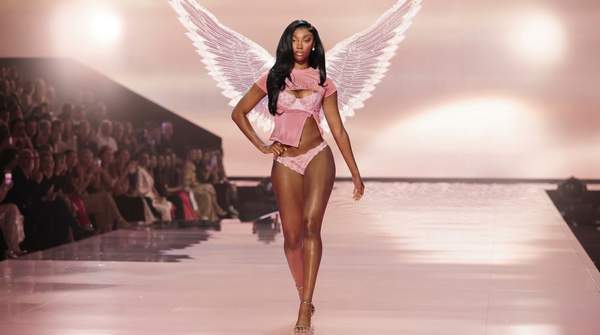
The 2026 Victoria's Secret Fashion Show was not one show. It was two, staged on the same runway: a nostalgic revival of diamond-encrusted fantasy for longtime fans, and a carefully documented push for cultural representation aimed at critics who helped cancel the spectacle in the first place. Read together, the two halves reveal a brand performing what its own chief creative officer calls a "tricky dance" — and the tension inside that dance is the real story of the night.
The Return of the Victoria's Secret Fashion Show: A Dual Strategy
I'll say this plainly: the 2026 show was a deliberate hybrid, and neither half of it was accidental. On one side, the brand revived the Fantasy Bra for the first time since 2018 — a $50 million piece designed with luxury jeweler Jacob & Co., worn by Kylie Jenner and set with 4,410 natural diamonds plus a 75.54-carat yellow diamond, as fan coverage of the show detailed. On the other, the runway carried Nanabah Grace, the first Navajo woman to walk the show, and Ravleen Varghese, an Indian model raised in Dubai making her debut.
That pairing is the strategic core. The show's return follows a bruising decade: the annual spectacle was canceled in 2019 after intense public backlash over its lack of racial diversity and body inclusivity, alongside scandals including a former CEO's ties to Jeffrey Epstein, as reported in coverage of this year's event. The 2026 production was, by design, an attempt to reclaim the old magic without repeating the old mistakes — or, depending on your read, to repeat them with new faces beside them.
Nostalgic Glamour: The 'Return to Form' Elements
The nostalgia pillar was unmistakable. Original Angels — Adriana Lima, Alessandra Ambrosio and Candice Swanepoel — returned to the runway, and the aesthetic coverage described as dominant was pure vintage: lacy pink lingerie, long tousled locks and the brand's signature aspirational silhouette. Viewers praised the production as a "return to form" following the 2021 rebrand that one expert, quoted in Daily Mail reporting, dismissed as an "identity crisis."
The Fantasy Bra was the emotional centerpiece, and I understand why. As one fan account of the show put it, the piece "was never meant to be ordinary lingerie" — its appeal lies in extraordinary craftsmanship and the anticipation of the reveal. The last one, in 2018, was a $1 million design worn by Elsa Hosk. Escalating to $50 million on Jenner signals something unambiguous: Victoria's Secret wants its old reputation for spectacle back, at full price.
Push for Inclusivity: Diverse Casting and Representation
Yet the same runway carried genuinely new history. Nanabah Grace, an IMG model and Victoria's Secret Angel who attended Montezuma-Cortez High School in Colorado, became the first Navajo woman to walk the show. "I would love to represent my people in the best way that I can, and with Diné, it's to walk in beauty," Grace told KOAT, adding that walking the show was "so, so surreal" and "every model's dream."
Ravleen Varghese's presence extended the same thread. As Gulf News reported, she joined a small group of Indian and Indian-origin models to appear on the runway, alongside Ujjwala Raut, Bhumika Arora and British-Indian model Neelam Gill, who returned for her third consecutive show. Varghese's path — schooling in Dubai, fashion design at the National Institute of Fashion Technology in Delhi, where she won the Handloom Heritage Award — is precisely the kind of story the pre-2019 show never told.
Victoria's Secret 2026 Fashion Show: A Strategic Juxtaposition
Here is the framework I'd use to evaluate the show: two strategic pillars, side by side, each with its own manifestation and intended audience. The contradiction — and the calculation — becomes visible only when you see them together.
| Strategic Element | Manifestation in 2026 Show | Intended Appeal |
|---|---|---|
| Nostalgic Glamour: Return of original Angels | Adriana Lima, Alessandra Ambrosio and Candice Swanepoel walked the runway again | Longtime fans who missed the brand's signature spectacle |
| Nostalgic Glamour: Fantasy Bra revival | First Fantasy Bra since 2018 — a $50 million Jacob & Co. piece with 4,410 diamonds, worn by Kylie Jenner | Re-establishing the show's luxury spectacle and cultural dominance |
| Nostalgic Glamour: Classic aesthetic | Lacy pink lingerie and the brand's traditional runway look, praised by viewers as a "return to form" | Audiences who rejected the 2021 rebrand as an "identity crisis" |
| Modern Inclusivity: Diverse casting | Nanabah Grace became the first Navajo model to walk the show; Ravleen Varghese made her debut | Critics of the brand's historical lack of racial diversity |
| Modern Inclusivity: Cultural representation | Grace represented her Diné culture; Varghese joined a small group of Indian and Indian-origin runway models | A new, culturally aware consumer base the brand needs to win back |
| Modern Inclusivity: Stated brand positioning | Chief creative officer Adam Selman described balancing sexiness, playfulness and desirability as a "tricky dance" | Signaling change without abandoning the fantasy that differentiates the brand |
The table's logic is simple: every nostalgic element re-engages the audience that made the show a phenomenon, while every inclusive element answers the backlash that ended it. Neither column explains the show alone. The strategy only makes sense — or only becomes contradictory — when you read across the rows.
The 'Tricky Dance': Commercial and Cultural Motivations
Why attempt both at once? Because the brand's own leadership says it must. "I think that we're sort of this idea of the American dream, and certainly the American fantasy," Adam Selman, Victoria's Secret's executive vice president and chief creative officer, told Vogue backstage. Under his purview, the brand has had to execute what he describes as a tricky dance — "to be sexy without being prurient, playful without being cheesy, desirable without being condescending."
The commercial logic is equally explicit. Expert commentary cited in Daily Mail reporting argued the earlier rebrand struggled to connect its message of inclusivity and female empowerment to the "emotional appeal" that historically differentiated Victoria's Secret: customers buy a feeling, a fantasy and an identity, not just lingerie. CEO Hillary Super, hired in September 2024 from Anthropologie and Savage X Fenty, has emphasized a vision that is "sexy, glamorous and luxurious" — language that points backward as much as forward.
Evaluating the Trade-Offs: Legacy vs. Modernity
Here is where I think the strategy gets genuinely difficult to judge — and where I refuse to pretend there's a clean verdict. Allure's review of the show read the message bluntly: "Body positivity was a limited-time offer." That critique has force. A $50 million diamond bra and a runway of protruding collarbones sit uneasily beside a first Navajo Angel, and the brand is asking both audiences to see themselves in the same production.
But the inclusive castings are not window dressing either. Grace's and Varghese's appearances were covered as historic firsts and significant representation moments, not as footnotes. The trade-off, then, is real on both sides: leaning into nostalgia risks confirming critics who say nothing changed, while leaning fully into the 2021 rebrand risks the commercial irrelevance that, per the expert commentary, followed it. The 2026 show chose to hold both positions simultaneously — a bet that the two audiences overlap more than the discourse suggests.
Navigating the Rebrand: A Continuous 'Tricky Dance'
Victoria's Secret is actively attempting to navigate a complex rebrand by simultaneously embracing its legacy of aspirational glamour and responding to contemporary demands for inclusivity and cultural representation — and the 2026 show is the clearest evidence yet of how deliberately it is doing both. The brand has not resolved the tension; it has staged it.
Whether the dance succeeds won't be settled by this one night, and no post-show sales or viewership data is yet available to settle it. The measurable indicator to watch is concrete: future Victoria's Secret fashion shows and marketing campaigns will continue to reveal the brand's evolving balance between nostalgic elements and diverse representation, indicating the success or ongoing tension of this strategic dance. If the Angels and the Fantasy Bra return alongside an expanding, genuinely diverse cast, the hybrid holds. If one column quietly empties, you'll know which audience the brand finally chose.
Sources
- Victoria's Secret's 'woke' rebrand was 'identity crisis,' expert says — Daily Mail
- First Navajo model walks Victoria's Secret Fashion Show runway — KOAT
- From a Dubai schoolgirl to sharing the Victoria’s Secret runway with Kylie Jenner: Meet Ravleen Varghese — Gulf News: Latest UAE news, Dubai news, Business, travel news, Dubai Gold rate, prayer time, cinema
- Victoria’s Secret Wants Us to Bring Back the Bad Old Days — Allure


