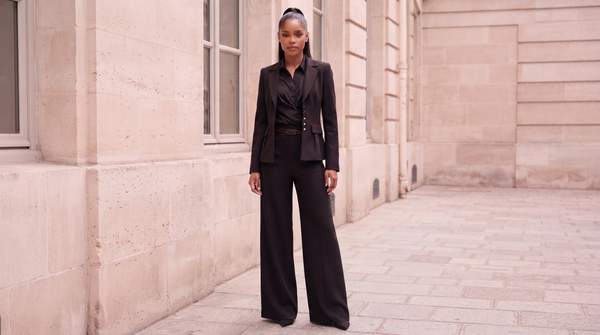
The women's suit did not arrive fully formed in a corporate boardroom. It evolved over three centuries, and every change in its shoulders, waist, and hemline tracked a change in what women were allowed — and then demanded — to do. That, to me, is what makes the power suit one of fashion's most compelling artifacts: it is a garment whose silhouette is a running commentary on women's social and professional standing.
The story runs from practical equestrian wear in the 1660s, through the Suffragette Suit of the 1910s, Coco Chanel's tweed revolution of the 1920s, Yves Saint Laurent's trousered tuxedo of the 1960s, and finally the broad-shouldered corporate armor of the 1980s — before softening into the minimalism of the 1990s. This article traces that Western lineage, era by era, and shows how each silhouette answered a specific cultural moment.
The Evolving Silhouette of the Women's Suit
Before diving into the designers, it helps to see the whole arc at once. The table below synthesizes the historical record into a single model, tracking three silhouette components — shoulders, waist, and lower garment — and correlating each era's design changes with its documented social context. Read down the columns and a pattern emerges: as women's public and professional roles expanded, the suit moved from borrowed practicality to deliberate authority, then relaxed once that authority no longer needed to be shouted.
| Era | Key design elements | Key designers / influences | Cultural significance |
|---|---|---|---|
| Late 17th century | Tailored, structured jackets worn with long skirts for riding | Equestrian wear adapted from men's clothing | Practicality that, as Tailor Made London's history notes, "shocked some contemporaries" |
| 1910s | Sharp tailored jacket and long skirt; a deliberate counterpoint to the ankle-narrowing "hobble skirt" | Suffragette Suit; associated with the "New Woman" | Freedom of movement for rallies, marches and public life |
| 1920s | Tweed suit: collarless button-up jacket with braid trim and metallic buttons, tight skirt, fitted sleeves | Coco Chanel | Anti-corsetry liberation; masculine sportswear fabrics claimed for women |
| 1930s–40s | Trousers enter the wardrobe, on screen and off | Marlene Dietrich; Marcel Rochas's first ready-to-wear pantsuits; Katharine Hepburn | Trousers normalized as everyday wear; brief postwar lull as traditional domestic roles returned |
| 1960s | Sleek trousers with a tailored tuxedo jacket | Yves Saint Laurent's "Le Smoking" | A bold assertion of women's right to dress as they pleased in male-dominated spaces |
| 1980s | Padded, exaggerated shoulders; wide lapels; oversized tailoring; thick fabrics; bold colors; cinched lines | Giorgio Armani; Donna Karan | A "uniform for success" for women climbing the corporate ladder |
| 1990s | Softened shoulders, streamlined and minimalist tailoring | Business-casual shift; designers' own revision of power dressing | Understated authority; the era of overt power dressing in decline |
The Origins of Women's Tailoring: From Riding Habits to Suffragette Suits
Tailoring for women begins, improbably, on horseback. As Lloyd Stratton recounts for Tailor Made London, women's structured jackets and long skirts for riding emerged in the 1660s — a practical borrowing from men's equestrian wear that scandalized some observers at the time. The garment was born of function, not fashion, and that functional DNA never left the women's suit.
The next leap came not from a designer but from a movement. The Suffragette Suit of the 1910s, as Michael Andrews Bespoke's history describes, was a sharp counterpoint to the "hobble skirt" then in mainstream fashion — a garment so narrow at the ankles that wearers literally hobbled. Rallies, marches and civil disobedience demanded less restrictive clothing, and this tailored jacket-and-skirt ensemble provided it. Marlen Komar, writing for Bustle, ties the style to the "New Woman" described by the Smithsonian: bolder, more active, more out-and-about in the world than her mother's generation. The suit, from its earliest political incarnation, was clothing built for public life.
Coco Chanel and the Liberation of the Women's Suit
Chanel is widely credited with the earliest iteration of power dressing, and her 1925 tweed suit remains the template. As The Style Historian's account details, it paired a tight skirt with a collarless button-up jacket, typically finished with braid trim, metallic buttons and fitted sleeves. The details mattered less than the material: tweed was a fabric commonly used in men's sportswear, and Chanel deliberately imported that masculine texture and structure into women's wardrobes.
What I find most significant is her stated reasoning. Chanel is believed to have designed the suit to adapt to a changing lifestyle brought on by World War I, when women entered more male-dominated spaces. The suit was not a costume; it was equipment for a new way of living. And as Michael Andrews Bespoke notes, the Suffragette Suit itself had inspired Chanel — the lineage from political pragmatism to modern elegance is direct. Her relaxed, corset-free silhouette challenged the structured underpinnings of previous decades and made comfort itself a statement of independence.
Yves Saint Laurent's 'Le Smoking': Challenging Gender Norms
If Chanel borrowed men's fabrics, Yves Saint Laurent borrowed the tuxedo itself. His "Le Smoking," introduced in the 1960s alongside André Courrèges's futuristic tailoring, adapted men's formal wear for women with sleek trousers and a sharply tailored jacket. As History Is Now Magazine's history of the female power suit puts it, the pantsuit was "not just a fashion statement but a bold assertion of women's right to dress as they pleased and occupy spaces traditionally dominated by men."
The trouser had already been fighting for legitimacy. Marlene Dietrich publicly championed the pantsuit in her professional and personal life, Marcel Rochas created the first ready-to-wear women's pantsuits, and Vogue published its first spread featuring women in trousers in 1939. Katharine Hepburn's highly publicized preference for trousers on and off set helped solidify them as everyday wear, according to the Michael Andrews Bespoke account. Saint Laurent's contribution was to formalize the trouser — to make it evening wear, and by extension, to make the question of whether women could wear men's clothing feel permanently answered.
The 1980s Power Suit: A Uniform for Corporate Success
The 1980s are often regarded as the golden age of the power suit, and the description is earned. This was a decade of excess and ambition, and the suit reflected it: bold, exaggerated shoulders, wide lapels, tailored lines, often paired with blouses featuring dramatic bows or ruffles. The Style Historian's account credits Giorgio Armani as the pioneer of the power suit, with key elements including padded shoulders, large lapels, oversized tailoring, thick fabrics and bold colors.
But the power suit was more than a look — it was a strategy. It was seen as pivotal in helping women shatter glass ceilings, serving as a way to curate an image aligned with executive roles and becoming, in The Style Historian's phrase, "a uniform for success." History Is Now Magazine's account agrees: designers such as Armani and Donna Karan became synonymous with the suit, which became a staple for women climbing the corporate ladder, symbolizing confidence, authority and a break from traditional gender roles in the workplace. The padded shoulder, in other words, was architecture — a built silhouette that occupied space the way its wearer needed to.
Evolution Beyond the 80s: Softening Silhouettes and Modern Interpretations
Then, near the end of the 1980s, the tailoring began to soften. The Style Historian traces this softening continuing through the 2000s, with corporate looks becoming slimmer and skirts being replaced by trousers. In the 1990s, the exaggerated features of the previous decade were toned down in favor of minimalist, streamlined designs, even as business casual rose and the power suit remained a professional wardrobe staple.
The deeper shift was cultural, not merely aesthetic. JSTOR Daily's history of the power suit, drawing on a 1990s study by researchers Kimle and Damhorst, quotes their finding that the move toward more creative, fashion-oriented business dress reflected women "not only asserting themselves, but also valuing themselves and their culture for what it is." Even John Molloy, whose dress-for-success doctrine had underpinned the era, revised his own opinions in a later edition of his book. The era of power dressing was in decline — not because women had less authority, but because they needed less armor to exercise it.
Understanding the Enduring Legacy of the Power Suit
Readers can recognize how specific design elements of women's suits have historically reflected and influenced women's social and professional standing. The pattern is consistent across the record: each silhouette change — from the hobble-skirt-defying Suffragette Suit to Chanel's sportswear tweed, from Saint Laurent's trousered tuxedo to Armani's padded shoulders — correlated with a documented expansion of women's public roles, and often helped drive it. This conclusion is a synthesis of the historical accounts cited here, which correlate design changes with social shifts from the suffrage movement through wartime labor to corporate leadership.
The measure of whether this history has landed is simple: you should now be able to articulate the cultural significance of at least three distinct suit silhouettes from different eras — say, the 1910s Suffragette Suit's freedom of movement, the 1960s "Le Smoking's" claim on male-dominated spaces, and the 1980s power suit's corporate authority. If you can look at a shoulder pad or a pair of tailored trousers and read the social history encoded in it, the suit has done its work.
Sources
- The Evolution of Women's Suits: From Riding Habits to Power Dressing — Tailor Made London
- A Brief History of Women's Suits — Michael Andrews Bespoke, New York's Most Trusted Custom Tailor Since 2006
- The Evolution Of The Female Power Suit & What It Means — PHOTOS — Bustle
- The history of power dressing — The Style Historianᵀᴹ
- Female Power Suit — History is Now — History is Now Magazine, Podcasts, Blog and Books | Modern International and American history
- The History of the Female Power Suit — History is Now Magazine, Podcasts, Blog and Books | Modern International and American history
- The History of the Power Suit for Women - JSTOR Daily