The Burberry trench coat became an icon through a precise sequence of events: a weatherproof fabric invented in 1879, a military commission that put functional hardware on officers' shoulders, a post-war civilian craving for officer style, and two Hollywood films that fixed the coat in the global imagination. Understanding that sequence explains why a garment designed for soldiers now defines cinematic cool—and why, more than a century later, museums and anniversary campaigns still orbit around it.
The Burberry Trench Coat: A Century of Evolution
The clearest way to see the coat's transformation is chronologically. Each milestone below marks a moment when the garment gained a new feature, a new audience, or a new meaning—and the sequence shows how each stage made the next one possible.
| Date/Era | Milestone | Significance |
|---|---|---|
| 1879 | Thomas Burberry invents gabardine | A breathable, weather-repellent fabric that transformed rainwear and made the coat's practical utility possible. |
| 1901–1912 | Officer raincoat commission and the Tielocken | Burberry was asked to design a lightweight raincoat for soldiers; the belted Tielocken, patented in 1912, was the trench coat's direct predecessor. |
| 1914–1918 | Trench coat developed for WWI officers | Epaulettes, D-rings, a storm shield and gun flap were introduced with purpose; more than 500,000 Burberry coats were worn by armed forces members. |
| Post-WWI | Civilian adoption | Officers kept wearing their coats in daily life, and civilians bought the coat as a status symbol of style and national pride. |
| 1942 | "Casablanca" | Humphrey Bogart's trench-coated role immortalised the coat as a piece of cinematic fashion. |
| 1961 | "Breakfast at Tiffany's" | Audrey Hepburn's rain-soaked search for Cat cemented the design as a classic for generations. |
| 2026 | 170th anniversary | Burberry launches the Gabardine Capsule and the "Portraits of an Icon" campaign, with a V&A display celebrating the coat's heritage. |
Read the table one way and it is a product history. Read it another and it is a study in how meaning accumulates: the fabric came first, the hardware second, the exclusivity third, the mythology last. Remove any single row and the later ones weaken.
The Birth of an Icon: Gabardine and Military Origins
Everything begins with fabric. In 1879, Thomas Burberry invented gabardine, whose open, reticular weave lets the body breathe while repelling the elements—safeguarding against what Burberry's own heritage account calls "the unpredictable British weather." That single innovation solved the central problem of nineteenth-century rainwear: protection without suffocation. Earlier rain gear could keep water out only by sealing the body in, which made it unbearable for anything but the shortest exposure. Gabardine did both jobs at once, and that is the foundation everything else rests on.
The fabric proved itself in extremes before it ever reached the battlefield. In 1908, polar explorer Ernest Shackleton used Burberry gabardine to cover his car's engine to prevent it freezing in Antarctica, according to the brand's history. An endorsement like that mattered commercially: if the material could protect machinery in polar conditions, its claims for ordinary rainwear needed no exaggeration.
The military connection came in 1901, when Burberry was asked to design a lightweight raincoat for soldiers—one that was comfortable, practical, and fitted with shoulder epaulettes so an officer could display his rank, as the National Army Museum records. In 1912 Burberry patented the Tielocken, fastened with a single strap and buckle and finished with a buttoned collar; it is widely regarded as the trench coat's forerunner. When the First World War arrived, the design was ready. Burberry developed the trench coat for military use between 1914 and 1918, and more than 500,000 Burberry coats were worn by members of the armed forces.
From Trenches to Mainstream: Functional Design Elements and Civilian Adoption
The coat's military details were engineered, not decorative. Epaulettes displayed officer rank; D-rings attached equipment; the storm shield and gun flap served soldiers directly in the field. Burberry's own account describes these features as "introduced with purpose." That phrase matters, because it explains the coat's later life: every strap and ring carried a story of function, and civilians could read that story at a glance.
Crucially, the coat was exclusive. The National Army Museum notes that "as enlisted men were not permitted to wear trench coats, the garment also became a status symbol." Its sophisticated style and practical function made it desirable even before the war ended. Civilians—male and female—bought the coat to show national pride and, in the museum's words, "excellent style." This is the pivotal transition in the coat's history: the garment crossed from uniform to wardrobe not because it was redesigned, but because of who wore it and who could not.
After the armistice, the transition was almost seamless: officers simply kept wearing their wartime coats in daily life, and the museum records that the coat remained popular after the war as a result. The coat that had been shaped by necessity became, in Burberry's telling, part of everyday life—"worn on wet mornings and busy city streets, a coat people return to and rely on." Function had become fashion without changing a single buckle. The hardware that once signalled rank and equipment now signalled taste, but it was the same hardware.
Hollywood's Endorsement: The Trench Coat on the Silver Screen
The Second World War gave the coat another combat outing, but its decisive transformation came from cinema. The National Army Museum is direct about this: "it was really the Hollywood films of the time, like 'Casablanca' (1942), which featured main characters wearing a trench coat, that immortalised its status as a fashion piece." Humphrey Bogart's Rick Blaine gave the coat a new vocabulary—no longer soldierly, but shadowy, romantic, morally ambiguous.
Hollywood dressed its leading men and women—from Bogart to Cary Grant, Audrey Hepburn, Simone Signoret, Greta Garbo and Lauren Bacall—in the trench coat to convey "allure, mystery, sometimes danger and seediness, daring and romanticism," as Alison Jane Reid writes in The Luminaries Magazine. The coat became costume shorthand for intrigue, and that shorthand was available to any audience member who bought one.
The 1961 finale of "Breakfast at Tiffany's" sealed it. Audrey Hepburn's climactic search for Cat, wrapped in a trench in the rain, was, as Molly Isabella Smith writes for Sotheby's, "very much as Thomas Burberry intended: rain-soaked in a downpour." The scene cemented the design as a classic for generations. Harper's Bazaar records the commercial echo: by 1965, one in five coats exported from Britain was a Burberry product—though the magazine also notes that the designer of Hepburn's specific coat remains a mystery, and that the moment likely fueled sales of the Burberry original rather than being one itself. The distinction is worth preserving: Hollywood did not always dress its stars in Burberry, but it made Burberry's design the reference point.
A Timeless Legacy: Contemporary Relevance and Cultural Celebrations
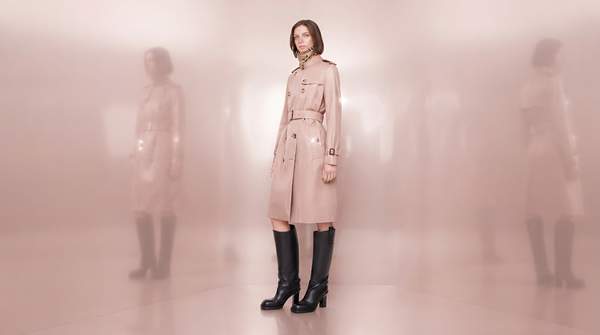
The coat's cultural standing is now institutionally recognised. To mark the house's 170th anniversary in 2026, Burberry launched a Gabardine Capsule collection followed by "The Trench, Portraits of an Icon," a campaign film with black-and-white portraits by Tim Walker, featuring a cast ranging from Kate Moss and Kristin Scott Thomas to Kid Cudi and Little Simz. The Victoria and Albert Museum, meanwhile, has announced a display dedicated to the coat for late 2026—placing a rain garment alongside the artefacts of British design history.
What the anniversary celebrations confirm is that the trench coat's meaning has been rebuilt layer by layer: a weatherproof fabric, a soldier's kit, an officer's privilege, a film star's costume, and finally a heritage object worthy of a museum. Each generation kept the hardware—belt, epaulettes, D-rings—and reinterpreted what it means to wear it. The brand still makes its heritage trench coats in a Yorkshire factory, with the Kensington and Waterloo cuts carrying the same signature details into the present.
Understanding the Enduring Appeal of the Trench Coat
Readers should recognise that the Burberry trench coat's enduring iconic status stems from a unique blend of innovative functional design, strategic military adoption, and powerful cultural reinterpretation through cinema and fashion. The coat never abandoned its origins; it accumulated meanings, and each one made the next easier to attach. The measurable indicator of that status is the coat's continued presence in fashion collections, cultural exhibitions, and popular media—as exemplified by Burberry's 170th-anniversary celebrations and museum displays, both unfolding in 2026. If the trench coat appears in the next decade's campaigns and exhibitions as reliably as it has since 1879, the pattern holds.
Sources
- The History of the Trench Coat — US
- The Fascinating History of the Burberry Trench Coat—And the Best Styles to Buy Now — Harper's BAZAAR
- Our Story — US
- From Shackleton to Stardom: The History of Burberry’s Trench Coat — Sothebys.com
- Army fashion statements — NAM
- Fashion Icon: The Trench Coat from the Battle Field to Audrey Hepburn in Breakfast at Tiffanys — The Luminaries Magazine