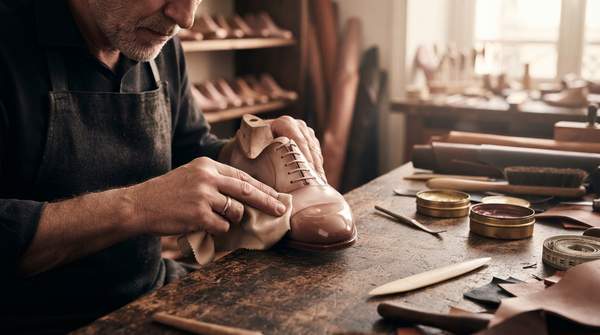
Bespoke shoemaking is not a purchase; it is a collaboration that unfolds in distinct, dependent stages. A pair of hand-crafted dress shoes begins as a conversation, becomes a carved wooden last, a paper pattern, a provisional trial shoe, and only then a finished object. Understanding that sequence is the key to appreciating why the craft endures in luxury fashion — and why the client's decisions at each stage matter as much as the artisan's hands.
What follows is the general arc of traditional bespoke shoemaking. I want to be clear about scope: specific steps and terminology vary between artisans and workshops, and this account focuses on hand-crafted dress shoes rather than boots or athletic footwear. It is a map of the craft, not a single workshop's manual.
The Journey Begins: Consultation and Design
Everything starts with a conversation. Some workshops, such as Maida's Bespoke Footwear, begin even earlier, with an initial phone consultation before the client ever visits the showroom. That first contact sets expectations and opens the collaborative relationship that defines bespoke work.
The design discussion is where the client's vision takes shape, and it is broader than most people expect. Writing about designing bespoke shoes with a shoemaker, Sven Raphael Schneider describes conversations that cover the heel, the sole and its thickness, the kind of leather, the lining, the colors — even whether one wants natural, non-chromed, aniline-dyed hand leather. The lacing system, or its absence, is its own decision point.
There is a piece of conventional wisdom worth interrogating here: that a first bespoke pair should be black cap-toed Oxfords. Schneider's view is that it depends entirely on preference and need — an investment banker who lives in black Oxfords should order exactly that, but the rule is not a law. I find that framing refreshing. The consultation exists to establish the aesthetic and functional requirements of the shoe, not to funnel you toward a default.
One practical observation from Schneider deserves emphasis: a good shoemaker is proud to show you their lasts, and a workshop without lasts on display is a warning sign. The presence of those carved wooden forms is visible proof that bespoke practice, not merely sales, happens there.
Crafting the Foundation: Measurements and Last Creation
Once the vision is agreed, the shoemaker turns to the foot itself. Measurement in bespoke work goes beyond static length and width. As the Italian Shoe Factory describes its process, it includes how a foot rolls when walking and how that gait affects factors such as heel height. The foot is studied in motion, not just in profile.
Those measurements feed the creation of the last — the custom wooden form around which the entire shoe is built. The last is placed inside the shoe during construction so the shoe can be modelled around it, and it is used again near completion to verify that the final fit matches the original design. In other words, the last is not a template that gets discarded; it is a working instrument consulted throughout.
This is why I consider last making the true foundation of the craft. The last dictates the shoe's shape, volume, and fit, making it a primary determinant of comfort. Every later stage — pattern, upper, sole — inherits its geometry from this carved block of wood. Get the last wrong, and nothing downstream can fully rescue the fit.