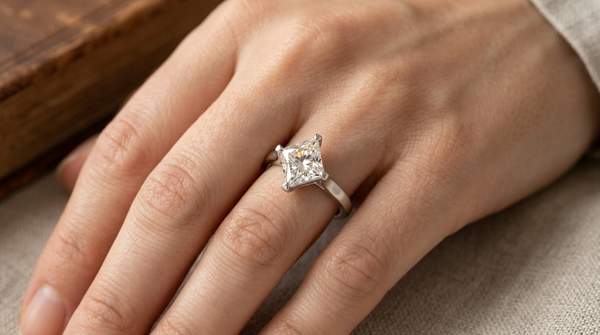
A princess-cut diamond usually sits in an engagement ring like a square, with its top and bottom edges running across the finger. Rotate that same shape until one corner points upward, and something striking happens. The square becomes a diamond-shaped silhouette, with four pointed corners directing the eye outward.
Ritani gives that orientation a starring role in its kite-set princess engagement rings. The Kat, The Augusta, and The Evelyn each approach the design differently, offering a choice between a restrained solitaire, diamond-accented shoulders, and a more decorative swirl setting. For someone who already loves princess-cut diamonds, these rings offer a fresh way to appreciate the shape.
The Princess Cut Looks Different on Its Point
Princess-cut diamonds are recognizable for their square or rectangular outlines, pointed corners, and brilliant-style faceting. Their appeal often comes from the contrast between a geometric shape and lively reflections across the stone.
In a conventional square orientation, the sides of a princess diamond tend to align with the horizontal and vertical lines of the setting. The resulting silhouette feels balanced and familiar.
A kite-set arrangement rotates the square so that its corners face up, down, left, and right. The top corner draws attention toward the fingertip, while the bottom corner directs the eye toward the hand.
The diamond retains its original cut and proportions. What changes is the relationship between its outline and the ring surrounding it.
That shift gives a familiar princess-cut stone a more directional appearance. The pointed silhouette is immediately recognizable, particularly when the band remains simple enough to let the diamond take center stage.
The Kat Keeps the Kite Setting in Focus
Ritani’s The Kat Princess Cut Kite-Set Solitaire Engagement Ring makes a compelling case for allowing the rotated diamond to lead the design.
Its solitaire construction gives the center stone room to establish its distinctive outline. With no row of side diamonds competing for attention, the princess cut becomes the principal visual feature.
The setting is offered in precious-metal choices including white gold and platinum, with individual configurations determining the exact available options. The Kat’s restrained band gives the point-up diamond a recognizable presence without introducing elaborate decoration.
This approach suits someone attracted primarily to the kite orientation. If the rotated square is what makes the ring interesting, a solitaire allows that preference to remain unmistakable.
Consider the difference between looking down at a traditional square princess solitaire and looking at The Kat. Both celebrate the angular center stone, but the kite arrangement emphasizes its corners in an entirely different way.
The result feels particularly contemporary because the shape itself supplies much of the drama. There is little need for additional ornament when the center diamond already establishes such a strong silhouette.
The Augusta Extends the Detail Along the Band
The Augusta Princess Cut Kite-Set Diamond Sidestone Engagement Ring introduces a different treatment.
Ritani places diamond detail along the band, creating a more decorated setting around the kite-oriented center. The center stone retains its pointed silhouette, but the surrounding diamonds bring additional sparkle into the composition.
That changes what the eye notices as it moves across the ring. The center establishes the principal shape, while the side diamonds connect it visually to the band.
Someone who likes the appearance of The Kat but prefers more diamond detail may find The Augusta particularly interesting. The setting adds ornament without abandoning the unusual orientation of the center stone.
It also creates a useful comparison with conventional princess-cut sidestone rings. In both cases, diamonds appear along the shoulders, but The Augusta uses a point-up center that changes how those accents relate to the main stone.
Ritani offers The Augusta in different precious-metal configurations, making the surrounding metal another part of the design decision.
The choice between The Kat and The Augusta is therefore about the overall composition. One emphasizes the isolated diamond shape; the other gives that shape a more sparkling setting.
The Evelyn Brings Movement Around the Center
Ritani’s The Evelyn Princess Cut Solitaire Kite Set Swirl Engagement Ring takes the design in a more sculptural direction.
Its swirling band treatment introduces curves around a center diamond defined by straight sides and sharp corners. The contrast between those elements gives the ring a recognizable personality.
Where The Kat presents a clean, direct silhouette, The Evelyn adds a sense of movement. The curved metal creates a different visual relationship with the princess diamond, drawing attention toward the center through the band’s shape.
That can appeal to someone who enjoys a slightly more decorative engagement ring but still wants the kite-set princess cut to remain central.
The combination is especially interesting because the stone and setting use different design languages. The diamond is angular and symmetrical; the surrounding metal brings a softer line.
Ritani’s product listing identifies The Evelyn as a kite-set swirl design, with precious-metal and ring-size selections available through its configuration options.
The ring offers another answer to the same initial attraction. A princess diamond on its point can work beautifully in a minimalist solitaire, but it can also anchor a setting with more visible movement.
Which Kite-Set Ring Has the Right Personality?
The three Ritani designs offer useful contrasts:
| Ritani Setting | Defining Detail | Overall Impression |
|---|---|---|
| The Kat | Kite-set solitaire | Clean and center-stone focused |
| The Augusta | Kite-set center with diamond sidestones | Sparkling and decorated |
| The Evelyn | Kite-set center with a swirl band | Curved and sculptural |
The comparison becomes especially helpful when the center-diamond shape has already been decided. Instead of returning to the beginning of the engagement-ring search, you can concentrate on what the surrounding setting contributes.
The Kat may appeal to someone who likes spare, geometric jewelry. The Augusta introduces more diamond detail, while The Evelyn offers a visible interplay between straight and curved forms.
There is no need to choose the most elaborate option simply because an engagement ring is an important purchase. The strongest design is the one whose overall appearance continues to appeal when you imagine wearing it regularly.
The Diamond Still Deserves Its Own Attention
Once a kite-set design catches your eye, the individual princess diamond becomes the next part of the decision.
Ritani allows shoppers to select natural or lab-grown diamonds for compatible engagement-ring settings. The available inventory can be considered by carat weight, measurements, color, clarity, and other listed characteristics.
A princess diamond’s pointed corners are important to its appearance, and the setting must accommodate and protect the chosen stone appropriately. The relevant Ritani configuration determines which diamond and setting combinations can be completed.
Face-up dimensions can also influence the finished impression. Two princess-cut stones with similar carat weights may have different measurements, so the overall appearance should be considered alongside the grading details.
Metal color adds another visual choice. A yellow-gold band can introduce warmth around the center diamond, while platinum or white gold creates a cooler surrounding color.
These details give the finished ring its individuality. The kite orientation establishes the design idea, while the particular diamond and setting configuration complete it.
Frequently Asked Questions
What is a kite-set princess-cut engagement ring at Ritani?
A kite-set princess engagement ring positions a square princess-cut diamond with its corners pointing up, down, left, and right. Ritani offers this orientation in named designs such as The Kat, The Augusta, and The Evelyn.
Does a kite setting change the cut of the diamond?
No. Ritani’s kite-set designs change the orientation of the princess-cut center stone within the setting. The diamond retains its original shape and faceting.
Which Ritani kite-set ring has diamond sidestones?
The Augusta is Ritani’s Princess Cut Kite-Set Diamond Sidestone Engagement Ring. Its band includes additional diamond detail around the distinctive center-stone orientation.
Can I choose a kite-set princess ring with a decorative band?
Yes. Ritani’s The Evelyn uses a swirl-band design around a kite-set princess-cut center. It provides a more sculptural alternative to the restrained solitaire appearance of The Kat.
Can Ritani kite-set rings use lab-grown diamonds?
Ritani offers natural and lab-grown diamond selections for compatible engagement-ring settings. The available choices depend on the specific ring design and individual diamond.
Make the Princess Cut the Design Statement
The most appealing part of a kite-set princess ring may be how a familiar diamond shape acquires a different presence through orientation alone. Ritani gives that idea three distinct treatments, from The Kat’s clean solitaire to The Augusta’s sidestones and The Evelyn’s curved band.
Compare Ritani’s princess-cut engagement rings, choose the kite-set design that suits your style, and pair it with a compatible diamond. Before purchasing, you can also check the email-and-text signup offer for qualifying orders of $1,500 or more, subject to its stated terms.